Stone veneer
$100 off stone veneer installation in Syracuse
Take $100 off your first job, then tell us about the wall that needs stone veneer installation in Syracuse. We scope the project, then introduce you to a local masonry contractor. Most quotes show you the stone and say little about the rest. This page starts with what you cannot see once the stone is on: the barrier, the flashing and the drained base.
- No obligationAsking for a price does not commit you. You can walk away after you hear it.
- Onondaga County focusThe projects and soil notes here fit Syracuse and nearby towns.
- Honest timing adviceIf your job belongs in spring, we say so early.
Tell us about the project
By sending this you agree to the terms and privacy policy. Prefer to talk? Call (315) 640-3590.
The Masonry Services Syracuse promise
- Asking for a price is free and never obliges you.
- We charge you no fee for scoping or the introduction.
- Your $100 credit follows the Terms, line for line.
- If an introduction goes wrong, we help put it right.
The masonry falls under the contract you sign with your mason.
When stone veneer fits
A bare block foundation
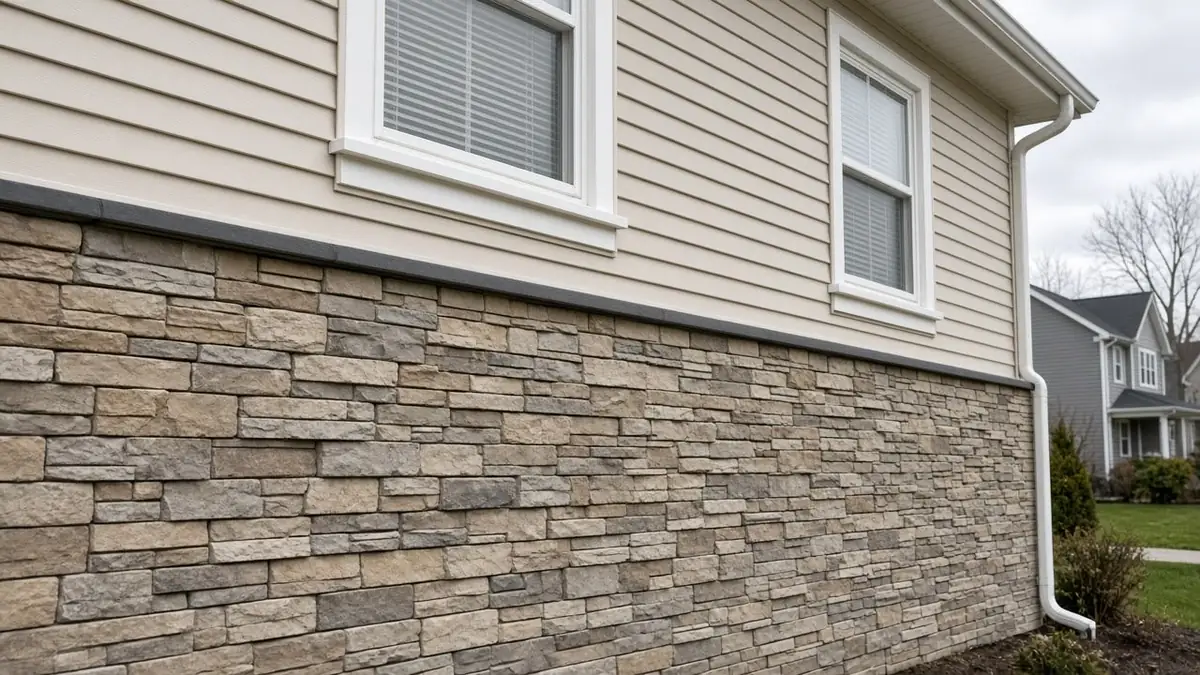
Gray block above the soil line is a common starting point. A stone or brick skirt gives the house a base and hides the block, as long as the wall behind it is sound and dry. Block takes a mortar bed well, and the skirt can stop at a course line or run up to the sill line. Keep the stone clear of the soil. For adhered veneer on stud walls, the code asks for at least 4 inches of gap above earth. Ask the code office what applies to a block wall.
An entry or porch wall
A flat wall beside the front door can carry a stone face, a pier or a pair of columns. Entries are small, so the detail work shows.
A chimney chase or fireplace wall
A framed chase clad in siding can take stone or brick veneer. This is new facing over a sound frame, not repair of an existing masonry chimney. A stone chase can give a patio or living room wall a strong focal point.
Columns, wainscot and sills
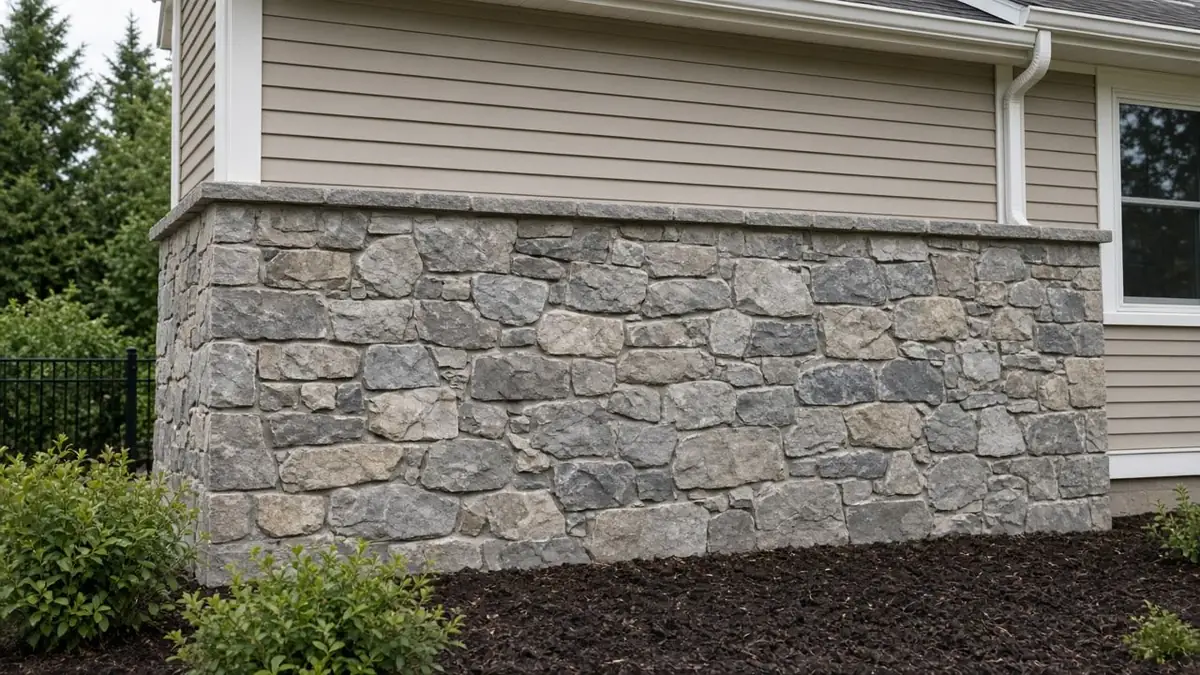
Short bands of stone at the base of a wall, around a garage or under windows give a wall weight without cladding the whole house.
A dated facade
Tired siding on a street-facing wall can be replaced with a mix of stone and siding. Partial facing keeps the cost sensible. A common compromise is stone to the window sills and siding above, which also limits the weight the wall must carry.
For adhered veneer on exterior stud walls, New York's residential code requires a water-resistive barrier lapped over the flange of a corrosion-resistant screed or flashing that extends at least an inch below the foundation plate line. Clearances are at least 4 inches above earth and 2 inches above paving. These are small, specific numbers you can check in a quote's scope.
Is stone veneer real stone?
It depends on the product. Natural thin veneer is cut from real stone. Manufactured veneer is a molded cement product colored to look like stone. Both need water managed behind them: barrier, lath and flashing. Ask which one is in the quote and what it weighs.
Can veneer go on a block foundation?
Yes, if the block is sound, clean and dry. Veneer covers a wall; it does not fix one. Cracked, leaning or damp block needs a repair contractor first, and that is a different job. Water is one of the three things efflorescence needs, so a damp wall is a reason to wait and fix the source before the white salt crust shows up on new work.
Why does veneer fall off some houses?
Water is the usual suspect. If the barrier, flashing or base drainage is wrong, water collects behind the stone and the damage can build where nobody can see it. Engineers who study these failures say the signs can take months or years to appear inside the house.
What is a weep screed?
A metal strip at the base of the wall with a vertical flange. The barrier laps over it so water that gets behind the stone runs down and out through the screed. It extends at least an inch below the plate line and must stay clear of soil: for adhered veneer on stud walls the code sets at least 4 inches above earth and 2 inches above paving.
Should I put two layers of barrier behind the stone?
Engineers who study failed veneer describe two layers of barrier for manufactured stone. The scratch coat bonds loosely to the outer layer, and the space between the two layers gives water a path to travel. Ask the contractor what the quote includes and why.
Can the work be done in winter?
It can, with protection, and the protection is a cost to ask about. Mortar between 32 and 40 degrees ambient is mixed with heated water or sand, and the industry says ice must not go into the mix. Most veneer is better scheduled between May and early October.
How does veneer compare with siding on cost and upkeep?
Compare more than the first number. Siding has its own paint and replacement schedule, while veneer's risk sits in the hidden detail, so its upkeep is only low if the water path was built correctly. A wall with a failed base detail costs far more to open up later than to build right.
What if I want a chimney rebuilt or repointed?
That is a different job. We scope new facing over sound walls and framed chimney chases. Repairs to old masonry go to a repair contractor.
What the work covers
- Thin and adhered veneer Manufactured and natural stone cut thin, set on a mortar bed over lath. This is the common suburban product and the one with the most hidden detail. Ask for the product name and weight per square foot, and check the manufacturer's installation sheet against the quote.
- Brick veneer and brick slips Full brick or thin brick set on a wall, with flashing and weep openings at the base so water can leave.
- Full-bed natural stone Thicker stone set in mortar on a ledge or footing. It weighs more and needs more support, so it is scoped differently.
- Water management behind the stone The barrier, lath, flashing and the screed at the base, specified and checked as part of the job rather than left to chance. You should see photos of each layer before the stone goes on, because after that nobody can check them.
Behind the stone
Read the stack from the top down. Ask where each layer appears in the quote.
- Veneer unitThe stone or brick you see. It sheds much of the rain but is not waterproof, so water that gets behind it has to be able to leave.
- Mortar and setting bedThe cement layer that bonds each unit. It needs material temperatures of 40 degrees Fahrenheit or higher to cure completely, so cold-weather work needs heated materials and protection.
- Lath and scratch coatMetal lath fastened to the wall holds a scratch coat of mortar that the stone is set into. Behind manufactured stone, engineers describe two barrier layers because the scratch coat bonds loosely to the outer layer and the space between the layers gives water a path.
- Water-resistive barrierBuilding paper or wrap behind the lath. It must lap over the flange of the base flashing so water runs out, not in.
- Flashing and weep screedFor adhered veneer on stud walls, a corrosion-resistant screed or flashing at the base, at least 0.019 inch (26 gage), with a vertical flange of at least 3 1/2 inches and extending at least an inch below the foundation plate line. This is the drain.
- Sheathing or block wallThe substrate behind everything. It has to be sound, plumb and dry before anything is attached to it.
How the project runs
- Scope the wall
Describe what is there now: block, framed wall or old siding. Have photos of the base and the soil line ready for the contractor's call. Say whether the wall is heated or unheated, whether there are downspouts or hose bibs on it, and how far the ground slopes toward it.
- Choose a material and a start window
Stone type, color and thickness affect weight and cost. The window matters as much: spring and summer are easiest for mortar.
- Meet the contractor
Ask the three quote questions, compare written scopes and decide. The contractor sets the price. Ask what happens to that price if the wall behind turns out worse than it looks.
- Check the layers before the stone goes on
Ask to see the screed, flashing and barrier before the stone covers them. Photos of those layers are worth keeping. Ask the contractor to show you the detail before it is covered.
What moves the cost
The contractor sets the price. These are the things behind it for stone veneer.
- Square footage of the face, and how much of it is corners, returns and openings.
- The stone itself: manufactured, thin natural or full-bed, and what it weighs.
- The condition of the wall behind. Rot, cracks and moisture have to be fixed before anything is attached.
- Height and access. A one-story skirt is simpler than a gable end that needs staging.
- Base detail. Work near soil, paving or a walkway needs clearance, and pulling siding down to install flashing adds labor.
- Season. Late-fall starts can need heated water, blankets or an enclosure. A quote for a November start should say how the protection is handled.
- Scaffolding, demolition and cleanup, which vary with the house.
Book here and we credit $100 on your first job.
- We credit $100 toward your first project booked through this site.
- One credit for each household and property.
- Good through December 31, 2026.
- Your mason sets the project price.
The Masonry Services Syracuse promise
- Asking for a price is free and never obliges you.
- We charge you no fee for scoping or the introduction.
- Your $100 credit follows the Terms, line for line.
- If an introduction goes wrong, we help put it right.
The masonry falls under the contract you sign with your mason.
Masonry Services Syracuse(315) 640-3590. Read the full wording
Timing and the weather
Veneer mortar follows the 40 degree rule. Spring through early fall is easiest, and by late October the contractor either prices cold-weather protection or schedules the work for spring. If a quote for a November start looks low, ask what protection is included. Wet cleaning has its own limit: masonry should not be cleaned in freezing weather, and water-based washing should happen only when the temperature will stay at or above 40 degrees until the masonry is dry.
Basis: Brick Industry Association, NOAA NCEI
Stone veneer in your town
Choose your town for the local view of this job.
City and inner ring
East and west
Ready to price stone veneer?
Send one short form or call. Nothing is booked until you say so.