Guide
What is behind stone veneer, and why it comes off walls
A stone-faced wall photographs well. What decides whether it is still on the house in fifteen winters is behind the stone: a barrier, lath, flashing and a place for water to leave. This guide explains each layer in plain terms and gives you the questions to ask any contractor before the stone goes up.
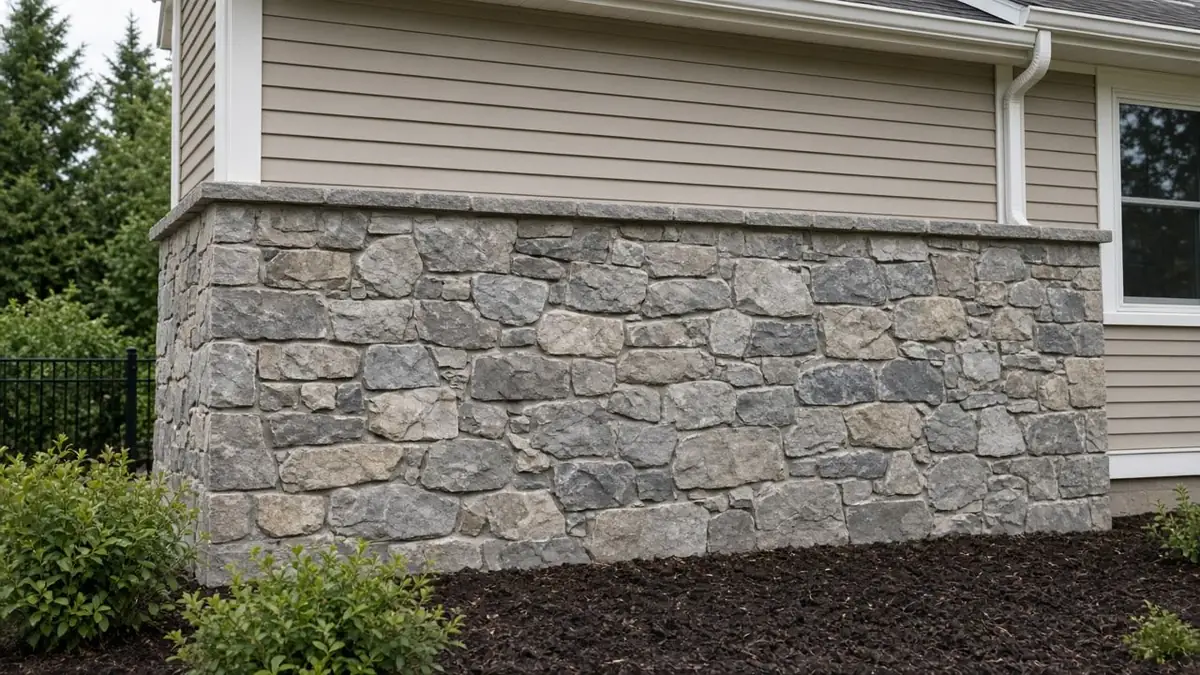
The stone is not what keeps the water out
Thin stone and brick veneer is a rain screen. It sheds much of the water that hits it, but water still gets behind it. The wall behind the stone is expected to handle that water. The code says so directly. New York's residential code says the exterior wall envelope must prevent water from accumulating within the wall assembly, by providing a water-resistant barrier behind the cladding and a means of draining to the exterior any water that gets past it.
So the question is not whether water gets behind your veneer. It does. The question is what it meets when it does, and where it goes next.
Layer one: the barrier
The water-resistive barrier is the building paper or house wrap fastened to the wall behind the lath. It is the last line of defense for the sheathing and the framing. On most houses it is hidden the day the stone goes on. A tear, a missing lap or a barrier that runs the wrong way stays for the life of the wall.
Lap direction is the key detail. Each layer should overlap the one below it, like shingles, so water runs down and out instead of in. At the base, the barrier must lap over the outside of the flashing flange. The code states this directly. The barrier over the flange carries water out of the wall. The barrier behind the flange carries it in.
Forensic engineers who study stone failures describe a second wrinkle. With manufactured stone, the mortar scratch coat bonds, loosely, to the outer layer of barrier. That leaves no gap for water to channel down. A second layer of barrier preserves a drainage path. Whether your contractor uses one layer or two, ask why.
Layer two: lath and the scratch coat
Metal lath is fastened through the barrier into the studs. It holds a scratch coat, a rough layer of mortar the stone is later set into. The lath is the structural backbone of the system, and its fasteners are one place where a punctured barrier must be sealed or lapped properly.
The scratch coat sets before the stone goes on. Then each stone is buttered and pressed into place with a setting mortar, and the joints are filled. If the mortar is not cured properly, for example because it was too cold, the bond can be weak. That is part of why cold-weather practice matters for veneer as well as for bricklaying.
Basis: Vertex Engineering Services
Ready to compare veneer plans? Tell us about the wall and ask for a price.
Layer three: flashing and the weep screed at the base
The bottom edge of the veneer is where the system is judged. For adhered veneer on exterior stud walls, a corrosion-resistant screed or flashing runs along the base. The code calls for a minimum of 0.019 inch, or 26 gage. It must have a vertical attachment flange at least 3 1/2 inches tall and it extends at least an inch below the foundation plate line. That lets water that runs down the wall exit at the bottom.
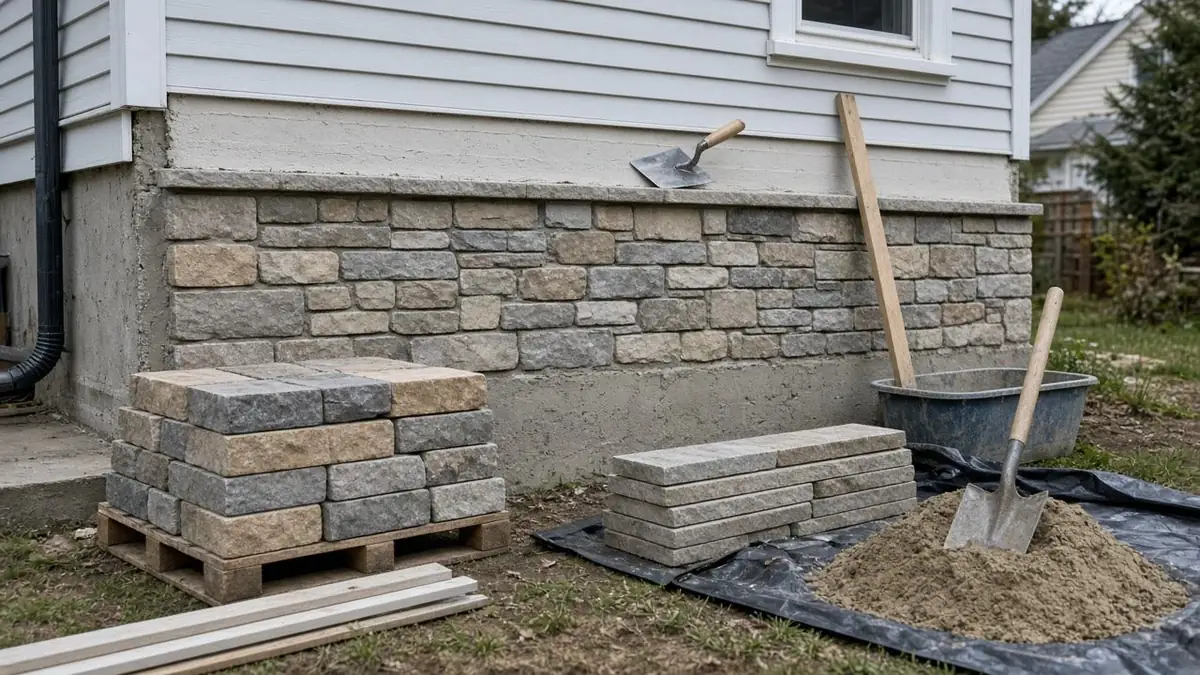
If mortar bridges the screed, or the stone is carried below it into soil, the drain is plugged. Water stays in the wall, and the sheathing and framing stay damp.
Basis: Brick Industry Association, Brick Industry Association
Clearances: the part you can check from the yard
For adhered veneer on exterior stud walls, the code sets minimum gaps between the veneer and what is below it. The face must stay at least 4 inches above the earth and 2 inches above paved areas. Over a walking surface supported by the same foundation as the exterior wall, a half inch is the minimum. These are simple measurements you can check with a tape. Stone that runs into the mulch bed is a sign of trouble. So is a patio or walk poured tight against the base of the stone.
Why it fails years later
The most frustrating thing about veneer problems is that they are slow. The same forensic research notes that moisture intrusion is not always apparent, because it can take months or years after construction for problems to show on an interior wall. Rot, mold and framing damage can build up silently. When a stone finally pops off, or a soft spot appears beneath a window, the cause was built in years ago.
Syracuse adds a long cold season to that, and water trapped behind stone can freeze there.
What a quote should say
Because you cannot see these layers after the job, the written scope has to name them. Look for these items in each quote.
- The water-resistive barrier: how many layers, and the lap details at windows and the base.
- The lath type and how it is fastened.
- The base flashing or weep screed, with its gauge and flange, and where it sits relative to the plate line.
- The clearance above soil and paving.
- The substrate: sheathing, or block that has been checked for soundness and dryness.
- The cold-weather plan, if the job runs past September.
Ask to see photos of each layer before the stone covers it. If answers are vague, treat that as information.
Ready to compare veneer plans? Tell us about the wall and ask for a price.
Signs of trouble on a finished wall
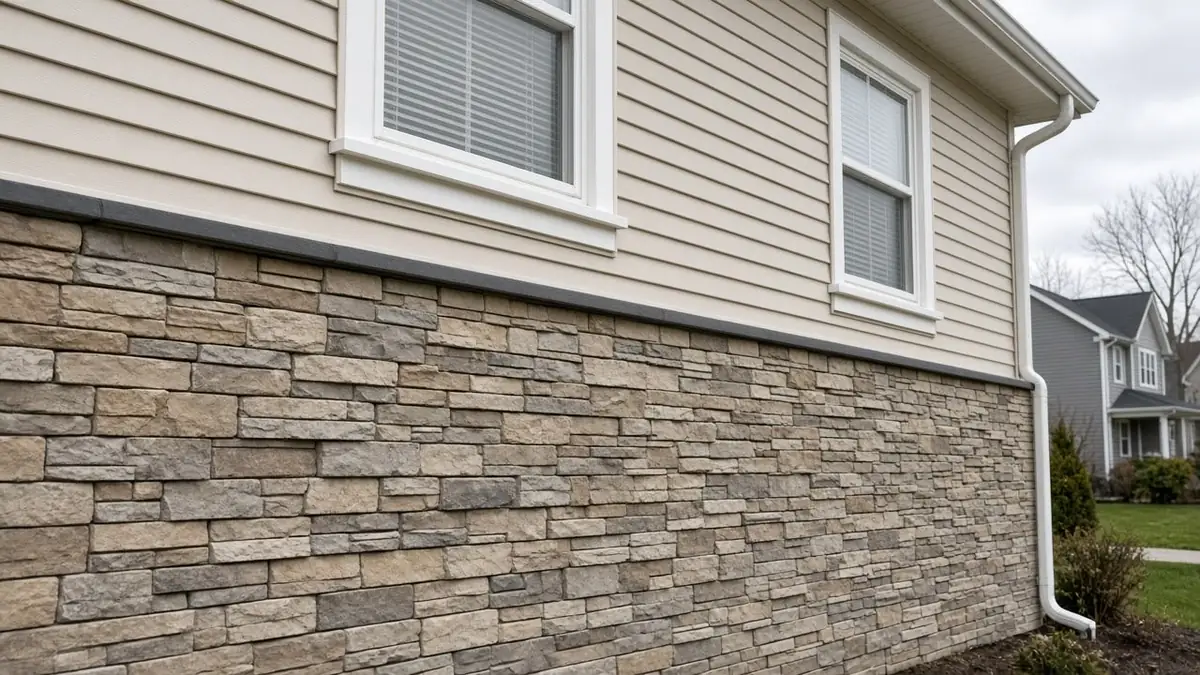
You can learn something from the wall itself, whether it is yours or a neighbor's. Stone that touches soil or mulch has no clearance and no working drain. Stains or a white crust at the base of the stone suggest that water is moving through the wall. Cracks in the mortar bed and soft spots in the sheathing are worth showing a contractor.
Look for a visible metal screed at the base of the stone. It should be clear of mortar and soil, with a small opening where water can leave. If you cannot find one, ask the contractor who built the wall what is there. Absence is not proof of failure, but it is a reason to look.
Questions for the walk-through
Before the stone goes on, ask the contractor to walk you through the wall at each stage. Ask to see the barrier laps at the base and at windows, the lath fastening and the screed with the barrier lapped over its flange. Take photos on your phone. Those photos are a record that costs nothing and can matter when you sell the house or if a problem appears.
Veneer over block and over old walls
Veneer on a block foundation is common, and block takes a mortar bed well. It still needs the water details. Water moving through block can carry salts to the surface, where they show up as a white crust. A cracked, damp or leaning foundation is a repair job, and facing it with stone only hides the problem. A chimney that needs rebuilding or repointing is a different job too.
Before you decide
Stone veneer is a good product when it is built as a system. The difference between a wall that holds and a wall that fails sits behind the stone, in a few inexpensive materials set correctly by someone who knew why. Ask the questions, compare written scopes and choose the contractor whose answers you can check.
Book here and we credit $100 on your first job.
- We credit $100 toward your first project booked through this site.
- One credit for each household and property.
- Good through December 31, 2026.
- Your mason sets the project price.
The Masonry Services Syracuse promise
- Asking for a price is free and never obliges you.
- We charge you no fee for scoping or the introduction.
- Your $100 credit follows the Terms, line for line.
- If an introduction goes wrong, we help put it right.
The masonry falls under the contract you sign with your mason.
Masonry Services Syracuse(315) 640-3590. Read the full wording
Ready to price your project?
Ready to compare veneer plans? Tell us about the wall and ask for a price.